 Skip to content
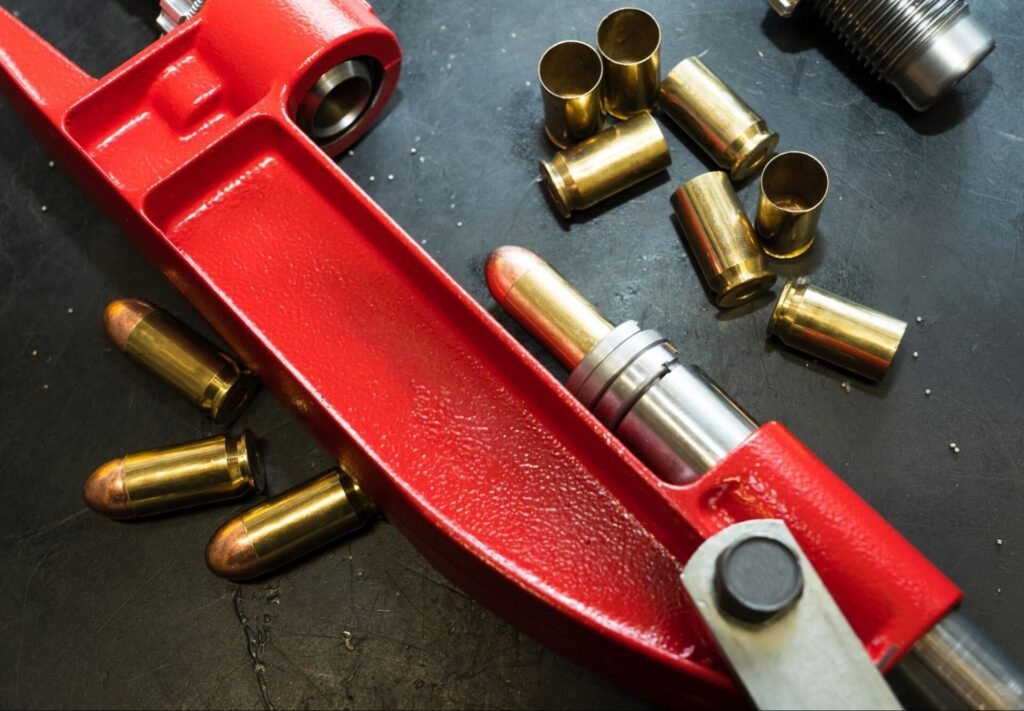
Reloading your own ammunition is one of the most rewarding pursuits available to licensed shooters in the UK and Europe. It gives you complete control over the performance of every round you fire, can significantly reduce your cost per round over time, and deepens your understanding of how firearms and cartridges work. But is reloading ammunition in the UK worth it for a beginner? This guide answers that question honestly and walks you through everything you need to know to get started safely.
Is Reloading Ammunition Legal in the UK?
Yes — reloading ammunition is perfectly legal for licensed firearms owners in the United Kingdom. If you hold a valid Firearms Certificate (FAC) that covers the calibre you wish to reload for, you are permitted to reload ammunition for your own use. Reloading for sale or commercial distribution requires additional licensing.
Components such as reloading powder (propellant) and primers are classified as explosives precursors in the UK. Since 2014, the purchase of reloading powders and primers requires end-user registration. Prime Guns Europe supplies these components to verified licensed buyers in compliance with all UK and EU regulations.
The Main Benefits of Reloading Your Own Ammunition
There are three compelling reasons why thousands of UK and European shooters reload their own ammunition:
- Cost savings: Once your initial equipment investment is recovered, reloaded ammunition consistently costs 30 to 60 percent less per round than factory loaded commercial ammunition for popular calibres like .308 Winchester and 9mm.
- Precision and customisation: You can tailor bullet weight, powder charge, and overall cartridge length to your specific firearm, producing loads that are often more accurate than off-the-shelf ammunition.
- Availability: During periods when commercial ammunition is scarce, reloaders with a stock of components can continue shooting when factory ammo shelves are empty.
�� PRO TIP: For precision rifle shooters, custom-loaded ammunition matched to your specific barrel’s freebore and throat can improve group sizes significantly compared to factory loads.
What Equipment Do You Need to Start Reloading?
Getting started does not require an enormous investment. A basic but fully functional reloading setup for a single rifle or pistol calibre can be assembled for a reasonable budget. Here is what you will need:
- A reloading press — single-stage presses are ideal for beginners and precision rifle work; progressive presses suit high-volume pistol reloaders.
- Die set — full-length sizing, seating, and crimping dies for your calibre.
- Powder scale and/or powder measure — essential for consistent and safe charges.
- Case trimmer — for rifle cases that stretch during firing.
- Priming tool — to seat new primers consistently.
- Callipers — to measure cartridge overall length (COAL).
- Reloading manual — essential. Never reload without published data from a reputable source such as Hodgdon, Hornady, or Lyman.
Browse our reloading equipment range for presses, dies, and accessories from trusted manufacturers.
Understanding the Four Key Components of a Cartridge
Every reloaded cartridge is built from four components. Understanding each one is fundamental to safe and accurate reloading:
1. The Case — the brass, steel, or aluminium casing that holds everything together. Brass cases can be reloaded multiple times with proper care. Inspect cases for cracks, splits, and excessive length before each use.
2. The Primer — the small cup at the base of the case that ignites when struck by the firing pin. It ignites the powder charge. We stock a full range of reloading primers from CCI, Federal, and Winchester across all standard sizes.
3. The Powder — the propellant that generates gas to drive the bullet down the barrel. Choosing the correct powder for your calibre, bullet weight, and application is critical. Browse our reloading powder range for powders from Hodgdon, IMR, Vihtavuori, Alliant, and Ramshot.
4. The Bullet — the projectile itself. Bullet selection affects terminal performance, accuracy, and the type of reloading data you must use. Always use the exact bullet weight and type specified in your load data.
The Reloading Process Step by Step
Here is a simplified overview of the reloading process for a rifle cartridge:
- Inspect and clean your brass cases. Discard any that show signs of cracking or damage.
- Resize and deprime — run each case through the full-length sizing die to resize the case and remove the spent primer.
- Trim to length — rifle cases stretch with each firing and must be trimmed to the correct overall length using your case trimmer.
- Prime the case — seat a new primer into the primer pocket using your priming tool.
- Charge with powder — weigh or measure the correct powder charge as specified in your reloading manual. Double-check every charge.
- Seat the bullet — run the charged case into the bullet seating die to set the bullet to the correct COAL.
- Crimp if required — some calibres, particularly pistol rounds, benefit from a crimping step to secure the bullet.
- Inspect each finished round before loading.
�� PRO TIP: Never work from memory alone. Always have your reloading manual open at the correct data table while you load. Start at the minimum charge listed and work up carefully.
Is Reloading Worth It for UK Shooters in 2026?
The answer depends on your volume, your calibre, and your goals. For shooters firing fewer than 200 rounds per month, the time investment may not justify the cost savings over factory ammunition. For shooters firing 500 rounds or more per month — particularly in rifle calibres like .308 Winchester, .223 Remington, or 6.5 Creedmoor — the cost savings are significant, and the investment in equipment pays back within 12 to 18 months.
Reloading also makes sense for shooters using specialist or harder-to-find calibres where factory ammunition is expensive or inconsistently available, such as .454 Casull or 6.5 PRC.
Where to Buy Reloading Components in the UK and Europe
Prime Guns Europe stocks a comprehensive range of reloading components for licensed buyers across the UK and European Union. Our reloading powder range includes Hodgdon Titegroup, Hodgdon H4895, IMR 4064, Vihtavuori N140, and many others. Our primer range covers CCI, Federal, Winchester, and Remington across small rifle, large rifle, small pistol, large pistol, and magnum variants. All hazardous reloading components are stored and dispatched in compliance with UK and EU dangerous goods regulations. Orders are shipped with full documentation and tamper-evident packaging. For guidance on purchasing reloading components in your country, consult your national firearms licensing authority or visit the BASC (British Association for Shooting and Conservation) for UK-specific guidance.
 English
  German
  Spanish
  Hungarian
  Scottish Gaelic
  French
  Swedish
  Finnish
  German (Austria)
  German (Switzerland)
  Norwegian
  Italian
  Greek
Greek  Polish
  Slovak
  Slovenian
  Dutch
Dutch  Bulgarian
  Danish