 Skip to content
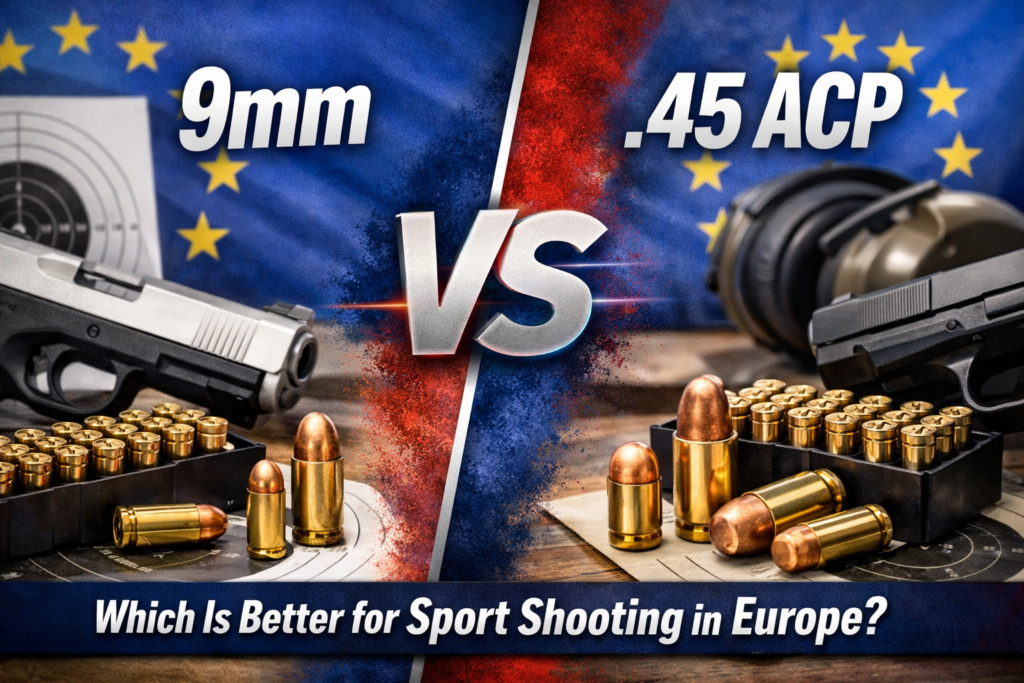
If you have spent any time researching handgun ammunition in the UK or Europe, you have almost certainly come across the debate between 9mm vs .45 ACP. It is one of the most enduring arguments in the shooting sports world — and for good reason. Both are excellent cartridges with different strengths, and the right choice depends entirely on your discipline, your firearm, and your shooting goals. In this guide, we break down everything European shooters need to know to make the right decision.
A Brief History of Both Calibres
The 9mm Luger (9x19mm Parabellum) was developed by Georg Luger in 1902 and adopted by the German military in 1904. It went on to become the standard sidearm cartridge across NATO and is today used by over 60 per cent of the world’s law enforcement agencies. Its combination of manageable recoil, high capacity, and low cost per round made it the most popular handgun calibre on the planet.
The .45 ACP (Automatic Colt Pistol) was developed by John Moses Browning in 1904 and adopted by the US military in 1911. For decades, it was considered the gold standard for stopping power due to its large-diameter 230-grain projectile. It remains deeply popular among competition shooters, collectors, and those who value terminal performance at close range.
Recoil — Which Is Easier to Manage?
For most European sport shooters, recoil management directly affects how quickly and accurately you can deliver follow-up shots. The 9mm has a clear advantage here. Its lighter bullet and lower operating pressure produce a sharp but controllable recoil impulse. Most shooters achieve faster split times with 9mm than with .45 ACP.
The .45 ACP produces what many describe as a slower, heavier push rather than a sharp snap. Some experienced shooters actually find this easier to manage than 9mm, but for new or intermediate shooters, the 9mm is generally the faster round to master.
�� PRO TIP: For IPSC and USPSA competition in Europe, 9mm is the dominant choice at Open and Standard divisions due to the combination of high capacity and fast split times.
Magazine Capacity — A Major Practical Difference
One of the most significant practical differences between these two calibres is magazine capacity. A standard double-stack 9mm pistol — such as the Glock 17 — holds 17 rounds. A comparable .45 ACP pistol typically holds 10 to 13 rounds in the same size frame.
For European sport shooters engaged in dynamic shooting disciplines or anyone seeking maximum capacity, the 9mm offers a meaningful advantage. For collectors shooting traditional 1911-style pistols or those competing in specific .45 ACP classes, capacity is a secondary concern.
Cost — How Much Does Each Round Cost in Europe?
Cost per round is an important consideration for anyone shooting regularly. In the UK and European market, 9mm full metal jacket training ammunition consistently costs less than .45 ACP. You will typically find 9mm available for 20 to 35 per cent less per round compared to equivalent .45 ACP loads.
For high-volume range training, this difference adds up quickly. A shooter firing 500 rounds per month will spend significantly less on 9mm over the course of a year. Browse our 9mm ammunition range at Prime Guns Europe for current pricing on training and defensive loads.
If you prefer the .45 ACP, we also stock a full range of .45 ACP ammunition from leading manufacturers, including Winchester, Federal, and Hornady.
Terminal Performance — Does .45 ACP Hit Harder?
The .45 ACP fires a 230-grain bullet at approximately 830 to 900 feet per second, producing a large diameter wound channel. The 9mm fires lighter bullets (typically 115 to 147 grain) at higher velocity. Modern defensive 9mm ammunition — particularly bonded hollow points such as the Speer Gold Dot and Federal HST — has largely closed the terminal performance gap.
The FBI’s ballistic testing and extensive law enforcement research from the 2010s onwards consistently demonstrated that modern 9mm hollow points achieve equivalent terminal performance to .45 ACP with better capacity and lower recoil. This research is one reason why so many European agencies standardised on 9mm.
Which Should You Choose for European Sport Shooting?
For dynamic shooting sports (IPSC, IDPA, practical pistol): choose 9mm. Greater capacity, lower cost for practice, and faster follow-up shots give you a competitive advantage.
For precision pistol shooting and traditional disciplines, either calibre is viable. .45 ACP is often preferred by shooters who value the heritage of the platform or compete in .45-specific classes.
For range training and recreational shooting, 9mm wins on cost. The lower price per round means more trigger time for the same budget — and trigger time is the single most effective way to improve your shooting.
For collecting and historical appreciation, .45 ACP, particularly in 1911-pattern pistols, offers a rich heritage and a shooting experience that many enthusiasts find deeply satisfying.
�� PRO TIP: Whichever calibre you choose, buy in bulk to reduce your cost per round. Browse our bulk ammunition range for the best prices on both calibres shipped across the UK and Europe.
Buying 9mm and .45 ACP Ammunition in the UK and Europe
Prime Guns Europe supplies both calibres to licensed buyers across the UK, Germany, France, Spain, Italy, and the Netherlands. Our 9mm ammunition category includes training FMJ loads, precision match rounds, and premium defensive hollow points from Winchester, Federal, Speer, Hornady, and more.
Our .45 ACP range covers everything from 230-grain FMJ practice loads to premium defensive rounds. All orders are processed in compliance with UK and EU firearms regulations with secure tracked delivery.
If you are buying a new handgun to go with your ammunition, browse our full handgun and pistol range for models chambered in both calibres from Glock, Sig Sauer, Smith & Wesson, and Taurus. For more information on ammunition and firearms regulations in your country, visit the UK Home Office firearms licensing guidance.
 English
  German
  Spanish
  Hungarian
  Scottish Gaelic
  French
  Swedish
  Finnish
  German (Austria)
  German (Switzerland)
  Norwegian
  Italian
  Greek
Greek  Polish
  Slovak
  Slovenian
  Dutch
Dutch  Bulgarian
  Danish